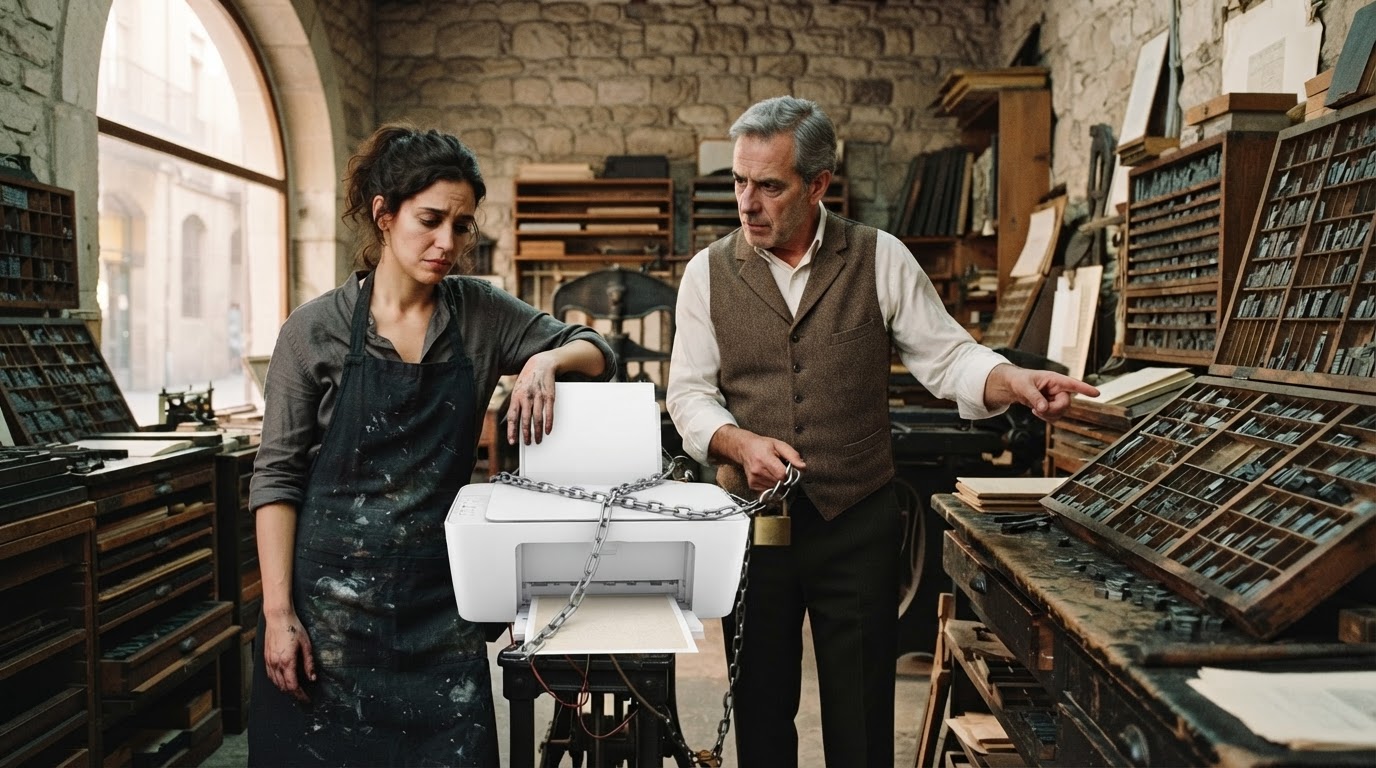
I recently helped someone automate a large part of her job with Codex. Much of it was copying and pasting between Excel sheets by hand, mind-numbing work. She showed what she had built to her management. They panicked. They took away her licence and told her to carry on copying and pasting by hand.
Her managers saw the job as doing the task. She saw it as reaching the goal. I told her to think about sinking ships and moving on.
I keep coming back to that story, because it is the opposite of what the public chatter about AI at work is about. That chatter is almost all about code: how many pull requests agents open, how fast an engineer ships, which coding tool wins. Coding matters, and I do it every day. But the value I see, in my own work, in the people I work with and in the work others share with me, is mostly elsewhere. Thinking about AI only as a way to build software faster is myopic. What is changing is what work is and how it gets done.
Mine, and other people’s
I am the person colleagues come to when they want to change how an office workflow runs, and most of what I build for myself isn’t software either. I prepare my day and my one-to-ones with LLMs. I triage what arrives, turn meeting notes into decisions and actions, draft the documents a leadership role produces, and keep a record of what was decided and why. I wrote about the second brain that holds all this back in April.
None of it would show up in a survey of AI coding productivity. All of it changed what my week looks like.
The examples I see in others look the same. When I took over a twice-yearly customer survey from a colleague who was changing roles, I asked everyone involved to walk through their part before we automated anything. The data lead arrived with his steps already written down, a plan to automate all of them, and a warning: automating them removed his manual role and left someone to maintain the result. He wasn’t asking how to do his task faster. He was redesigning the work, including his own share of it.
Across teams, the use is uneven in a way that has little to do with skill. One team I work with has automated its reports, its regression tests and its class scheduling. Another, with the same licences and the same training, is still struggling to let go of its manual processes. The tool is identical. What differs is whether people treat the steps they do every week as the job, or as one way of getting it done.
Seat, time, say
The people with the most to gain are often the least able to try. In my experience they are missing at least one of three things:
- A seat. Many companies have bought licences for engineers and leaders, and left out the people who spend their days on spreadsheets, forms and email.
- Time to slow down. Rethinking how you work takes a few quiet hours, and people whose week is full of manual work have the least slack to find them.
- A say. Changing how a job is done means changing what the business expects of it, and the people doing the job rarely get to decide that.
The woman with the spreadsheets had the seat. She didn’t have the say, and the people who did used it to stop her.
The task or the goal
There is a fair defence of her managers. Unreviewed automation on spreadsheets nobody else understands is a real risk, and taking the licence away could be read as caution.
It wasn’t caution, because caution would have asked to review the automation, test it and keep it. Banning it kept the risk where it was, in manual copying and the errors it always brings, and added a new one: it taught their most enterprising person that improving her own job gets punished. The managers defended the task and lost the goal.
This is the same mistake I described in who has to change for your AI agent to work: leaders plan from the tasks they can see, and the change they need sits with someone else.
From one person to a team
Where people are allowed to try, a second problem appears. Every chat starts from zero. Each person explains the team, the product, the people and how we do things here again, every time, and whatever one person works out stays with them.
The companies doing this well have solved it by giving the team a shared brain. I have been collecting examples from the podcasts I follow, and they share the same three layers:
- Context: what the team knows, like who owns what, current priorities, decisions and the glossary.
- Skills: how the team does things, like a launch checklist or a weekly status digest, written down once so the AI does them the same way for everyone.
- Connectors: live access to where the work happens, like the shared drive, the chat tool and the task tracker.
At Figma, a shared toolkit keeps 60 to 70 PMs working from the same skills, and the PM who built it, Ezra Mechaber, describes the aim as raising the floor. At Zapier, an executive assistant, Cortney Hickey, built a strategy companion loaded with the company’s strategy documents, so anyone can ask how a strategy affects their work. At Progyny, as Barry O’Reilly told One Knight in Product, the head of HR built an onboarding assistant for new joiners, and HR could suddenly see which questions people actually ask.
A wiki with a new name?
Companies have tried knowledge bases for decades, and they always go stale. The difference is who reads it. A wiki waits for a person to look something up. A team brain is read by the AI every time someone asks it to do the work, so a stale page shows up straight away as a bad answer, and the skills themselves can propose updates. It still needs an owner. Without one it goes stale like any wiki, which is why it is worth codifying the process before you automate it.
Start with one team and four weeks. Write the context as small pages with an index. Turn the three jobs the team most often forgets into shared skills. Use them on real work, with every output landing somewhere people without a seat can see it. Then review what nobody used, cut it, and decide whether to extend it.
Give the person who wants to try the seat, the time and the say. If your best people are still copying and pasting between spreadsheets by hand, ask yourself whether you see their job as the task or the goal.

Leave a Reply